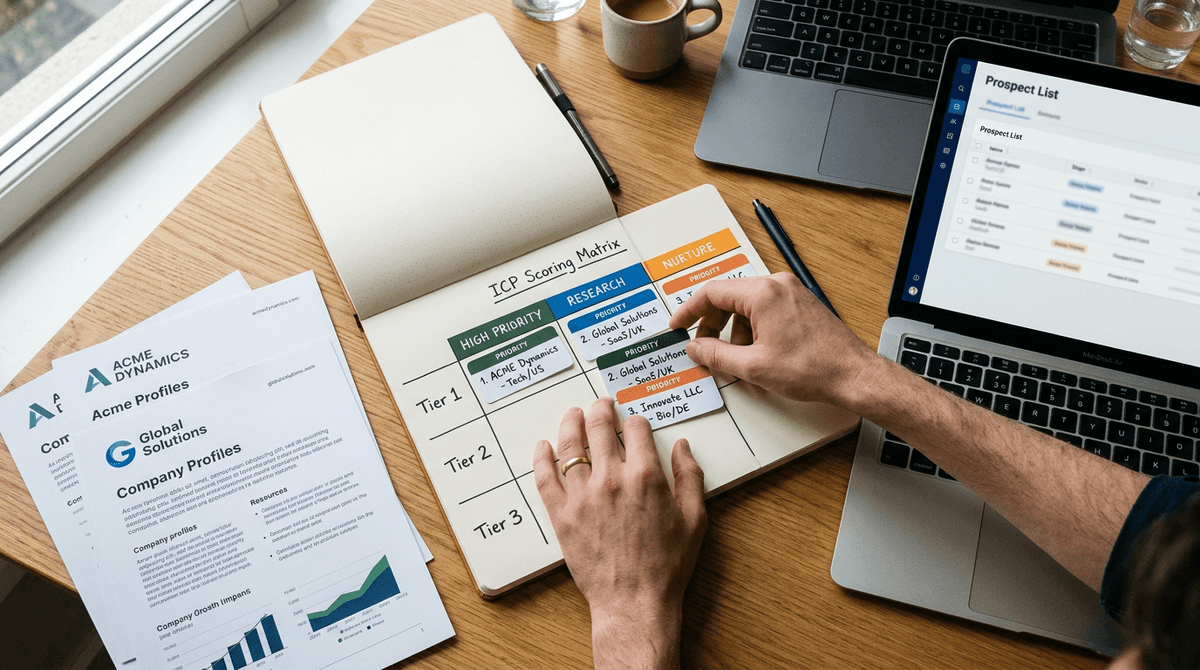
Sales prospecting is the work of finding the right potential customers and starting a conversation with them before they've raised their hand. It's the first stage of the sales process, and it's owned by SDRs, BDRs, and often AEs, whose job is to build a pipeline of qualified accounts before the actual sales cycle begins.
That's the simple version. The harder question, the one most guides skip past, is why prospecting still eats so many hours for so little return. You can have accurate contact data, a clean CRM, and a full calendar of dials and sends, and still watch reply rates sit flat and meetings stay hard to book.
This guide covers what prospecting actually is, how it's different from lead generation, the process that works, and where most teams get stuck even when they're doing everything "right."
What is sales prospecting, exactly?
Sales prospecting is the process of identifying companies and people who match your ideal customer profile, then reaching out to them directly to start a sales conversation. Unlike lead generation, which is largely marketing-owned and waits for someone to raise their hand, prospecting is sales-owned and proactive. The rep decides who to target and initiates contact.
A prospect isn't the same thing as a lead. A lead is anyone who's shown some kind of interest, like downloading a guide, filling out a form, or showing up on a webinar list. A prospect is someone a rep has actually vetted against their ICP and decided is worth pursuing. Not every lead becomes a prospect, and plenty of prospects never came through marketing at all.
| Stage | What it means | Who typically owns it |
|---|---|---|
| Lead | Shown some interest or fits basic criteria | Marketing |
| Prospect | Vetted against your ICP and worth pursuing | Sales (SDR/BDR) |
| Opportunity | Confirmed need, budget, and timeline | Sales (AE) |
Stage
What it means
Who typically owns it
Stage
What it means
Who typically owns it
Stage
What it means
Who typically owns it
Sales prospecting vs. lead generation
These two terms get used interchangeably all the time, and that's part of why so many teams end up with gaps between marketing and sales. Here's the actual distinction:
| Sales prospecting | Lead generation | |
|---|---|---|
| Motion | Outbound | Inbound |
| Who initiates | The rep | The buyer |
| Owned by | Sales | Marketing |
| Timeline | Immediate pipeline | Nurture, then pipeline |
Sales prospecting
Lead generation
Sales prospecting
Lead generation
Sales prospecting
Lead generation
Sales prospecting
Lead generation
Lead generation builds a pool of people who've expressed some interest. Prospecting is what a rep does to turn a specific, identified target into an actual conversation, whether or not that target ever came from a marketing campaign. Most healthy B2B pipelines need both.
Who does prospecting: SDR, BDR, or AE?
At most B2B companies, prospecting is the core job of Sales Development Reps (SDRs) or Business Development Reps (BDRs). These are usually newer sales hires who build a pipeline of qualified conversations, then hand off booked meetings to Account Executives (AEs), who run the actual sales cycle and close the deal.
That said, plenty of AEs prospect too, especially at smaller companies or in account-based motions where the same person owns an account from first touch to close. The title matters less than the job: someone has to find the right accounts and get a conversation started before anything else can happen.
Why prospecting still breaks down, even with good data
Here's where most guides stop short. They'll tell you prospecting requires accurate contact data, a clean target list, and personalized outreach, and that's true. But accurate contact data answers "who exists." It doesn't answer "what do I actually say to this person, and why would they care."
That second question is where most reps lose hours every day. A rep might have a perfectly good list of 50 accounts and still spend twenty minutes per account digging through LinkedIn, the company site, and old CRM notes just to figure out what's actually going on there before writing a single line of outreach. Multiply that across a full prospecting day and most of it isn't spent talking to prospects. It's spent trying to figure out what to say to them.
This is the part of prospecting that data providers don’t solve, because it’s not a data problem. It’s a “turn research into a plan” problem. More contacts and more firmographic fields don’t tell a rep whether a company’s recent hiring pattern matters, what their likely priorities are this quarter, or how to open a conversation that doesn’t sound like every other cold email that account got that week.
The sales prospecting process, step by step
Most effective prospecting motions follow the same five stages:
1. Define your ideal customer profile
Before you can prospect well, you need a clear picture of who's actually worth pursuing: company size, industry, tech stack, growth signals, and the roles most likely to feel the pain your product solves. An ICP that’s too broad just means more wasted outreach later.
2. Build and research your target account list
This is where most teams either buy a list from a data provider or pull one from their CRM, then start digging into each account individually. The research step is the one that quietly eats the most time: understanding what a company does, what’s changed recently, who the actual decision-makers are, and what might matter to them right now.
3. Prioritize based on fit and signals
Not every account on your list deserves the same amount of attention. Strong prospecting prioritizes accounts using real signals, such as hiring patterns, funding news, and leadership changes, alongside straightforward ICP fit, so reps spend their limited time on the accounts most likely to convert.
4. Personalize your outreach
Generic templates get ignored. The outreach that gets replies references something specific: a recent company move, a stated priority, a genuine reason the timing makes sense right now. This is also where multithreading matters, since most B2B deals involve more than one decision-maker, and reaching only one contact leaves you exposed if that person goes quiet.
5. Prepare for the conversation, not just the send
This step gets skipped constantly, and it’s the one that determines whether a booked meeting actually goes well. Knowing an account’s priorities isn’t the same as walking into a call with a clear point of view on their situation, likely objections, and what a strong next step looks like. Prospecting doesn’t end when someone replies. It ends when a rep is actually ready for the conversation that follows.
Common sales prospecting techniques
Most reps combine a handful of these, depending on their ICP and what their buyers actually respond to:
- Cold calling is still effective when reps have direct numbers and have done enough research to open with something relevant instead of a generic pitch.
- Cold email scales further than calling, but it only works with real personalization, since generic sequences get ignored or marked as spam.
- Social selling, mostly on LinkedIn, works best when a rep engages with a prospect’s content before sending a cold connection request.
- Referrals and warm introductions convert at a higher rate than any cold channel, simply because there’s already some trust in place.
- Account-based prospecting means researching a specific target account in depth and coordinating outreach across multiple stakeholders, rather than treating each contact separately.
How to measure sales prospecting success
Volume metrics (dials made, emails sent) tell you how busy a rep is. They don’t tell you whether prospecting is actually working. The metrics that matter most:
| Metric | What it tells you |
|---|---|
| Connect/response rate | Whether your targeting and messaging are landing |
| Meeting conversion rate | Whether booked conversations are worth having |
| Pipeline contribution | The dollar value prospecting is actually generating |
| Time to first meeting | How much friction sits between a lead and a real conversation |
Metric
What it tells you
Metric
What it tells you
Metric
What it tells you
Metric
What it tells you
A team can have a strong connect rate and still miss quota if the meetings that get booked aren’t well prepared. That’s why the best-performing teams don’t just track activity. They track what happens after the meeting gets on the calendar.
Common sales prospecting mistakes
Treating research and outreach as the same skill. Finding the right accounts is a research problem. Writing a message that gets a reply is a different skill entirely. Reps who are strong at one aren’t automatically strong at the other, and most training programs only cover the outreach half.
Optimizing for volume over fit. A list of 1,000 loosely-qualified accounts will almost always underperform a list of 200 well-researched, well-prioritized ones. More sends isn’t the same as more pipeline.
Stopping at the first message. Most prospects don’t respond to a single touch. Consistent, relevant follow-up, tied to something new each time rather than a generic “just following up,” is where a lot of pipeline actually gets built.
Showing up to the meeting under-prepared.A rep can do everything right up through booking a meeting and still lose the deal by walking in without a clear plan for that specific account’s priorities and likely objections.
What to actually look for in a sales prospecting tool
The sales prospecting tools market splits into a few genuinely different categories, and it’s worth knowing which one you actually need before you buy:
- Data providers give you contact and company information: emails, phone numbers, firmographics. This is the foundation, but data alone doesn’t tell a rep what to say.
- Workflow builders let technical teams build custom enrichment and outreach automations. They’re powerful, but they require someone to build and maintain the workflow.
- Sales intelligence and prep tools take the research a step further: turning account data into the actual insight, messaging, and prep a rep needs before they reach out or walk into a call.
Most teams end up stitching together two or three of these because no single tool covers the whole job. That’s usually where the real time loss shows up, not in any one tool being bad, but in the gaps between them.
Where Flyfish fits in
Flyfish sits in that third category. Instead of handing reps another database to search or another workflow to build, it takes account and lead research and turns it directly into what a rep needs next: a prioritized list of accounts, a clear read on what matters to the buyer, outreach that’s actually specific to them, and prep for the meeting itself. Data tells you who exists. Flyfish helps you figure out what to do about it. If you’re currently piecing together a data provider, a spreadsheet, and a handful of open tabs before every outreach send, that gap between “I have the data” and “I know what to say” is exactly what’s costing you the time. For a closer look at specific tools in this space, see how Flyfish compares to Apollo, ZoomInfo, and Clay.
Sales prospecting FAQs
What is sales prospecting in simple terms? It’s the work of identifying potential customers who fit your target profile and reaching out to start a sales conversation, before they’ve shown any interest on their own.
What’s the difference between a lead and a prospect? A lead has shown some interest but hasn’t been vetted. A prospect has been checked against your ideal customer profile and judged worth pursuing, whether or not they came from a marketing campaign.
Is prospecting the same as cold calling? No. Cold calling is one prospecting technique among several, including cold email, social selling, referrals, and account-based outreach. Most effective prospecting motions combine more than one.
How long does sales prospecting take? It varies widely by ICP and deal size, but the research step (understanding an account before reaching out) is usually the most time-consuming part, often taking longer than writing the outreach itself.
What tools do I need to prospect effectively? At minimum, a way to find accurate contact and company data. Beyond that, most teams also need a way to prioritize accounts by fit and signal, and a way to turn research into messaging and meeting prep, since data alone doesn’t do that work for you. See our guide to sales intelligence software for how these categories compare.