Account research

How to Build a Prospect List That Reps Actually Want to Use

Learn how to make a prospect list in sales that reps actually work, with the ICP, sourcing, and context steps most guides skip.

By Flyfish
Jul 3, 20268 min read

A prospect list in sales is a working set of companies and contacts your team plans to reach out to, organized enough that a rep can pick it up and start selling without doing extra research first. Knowing how to make a prospect list in sales is a basic skill. Knowing how to make one that a rep will actually open, work, and keep using past week one is a different problem, and it's the one most guides skip.

Sales teams build lists constantly. Most of those lists get worked hard for a few days and then quietly abandoned. That's rarely because the targeting was wrong. It's because the list ran out of reasons to keep engaging: no fresh context, no sense of which accounts actually mattered this week, just a static column of names that started to feel like homework. This guide covers the standard steps, ICP, sourcing, qualifying, but spends real time on the part that determines whether the list survives past its first week: keeping it usable.

Step 1: Define your ICP before you touch a single name

Every good prospect list starts with a clear ideal customer profile, not a list of names. Skipping this step is the single most common reason lists underperform. Without a defined ICP, "build a list" becomes "collect anyone who might plausibly buy," and that vague targeting shows up later as low reply rates and reps who don't trust the list enough to work it seriously.

A usable ICP definition covers company-level fit (industry, employee count, revenue range, growth stage) and person-level fit (job function, seniority, and what problem this specific role is accountable for solving). For a B2B sales intelligence product, for example, the company fit might be mid-market to upper-mid-market companies running outbound or account-based motions, and the person fit might be SDRs, BDRs, and AEs, not sales leadership as the primary buyer.

The sharper this definition is, the less time your team wastes qualifying leads that were never going to convert, and the more confident reps are that a name on the list is worth their time.

Step 2: Source from more than one place

Most prospect lists lean on a single source, usually a data provider, and that alone limits list quality. A stronger list draws from several:

CRM data. Past opportunities, closed-lost accounts worth revisiting, and existing contacts who changed companies are often the highest-intent source available and the most overlooked.

Data providers. Tools like ZoomInfo, Apollo, or Cognism give you scale and firmographic accuracy for filling out a list against your ICP criteria.

Referrals and warm introductions. Existing customers and internal network connections convert at meaningfully higher rates than cold-sourced names, and they're worth prioritizing even though they don't scale as easily.

Intent signals. Job changes, funding announcements, hiring surges, and competitor mentions indicate a company may be actively evaluating solutions right now, not just theoretically a fit.

Combining sources also protects against the biggest risk of buying a bulk list outright: outdated contact information, non-compliant data, and reps burning goodwill chasing dead numbers. A blended approach, CRM plus provider plus signals, tends to produce a list that's both large enough to work and accurate enough to trust.

Step 3: Qualify and prioritize, don't just collect

A list of a thousand names with no prioritization is functionally the same as no list at all, because a rep still has to guess where to start. Segment prospects by a combination of fit and intent:

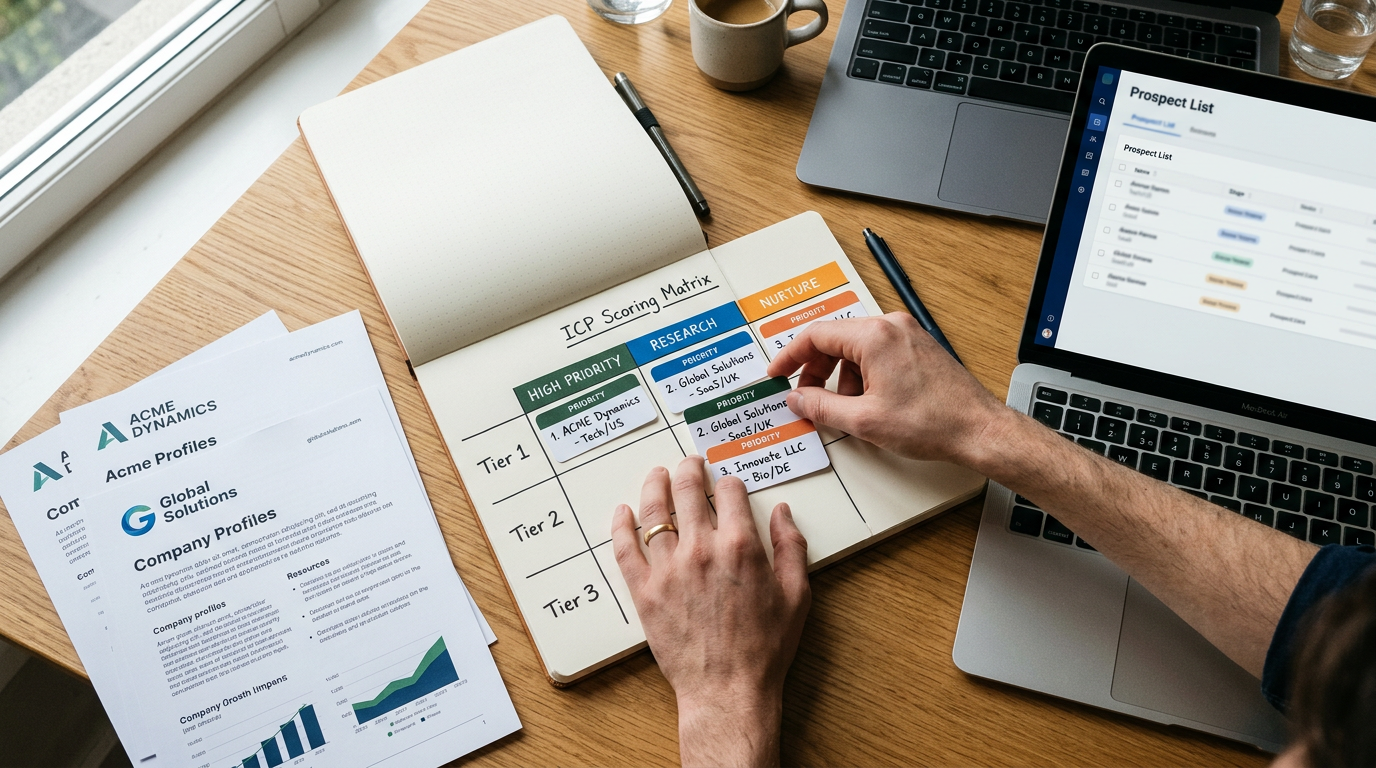
Fit is how closely the account matches your ICP criteria. Intent is whether anything currently suggests they're in-market: a recent trigger event, engagement with your content, or a signal like new hiring in a relevant department.

High fit plus high intent should be worked first, every time. High fit with no current intent is worth keeping on the list for nurture and monitoring, not immediate high-effort outreach. Low fit, regardless of intent, is usually better removed than kept, because it dilutes the list's credibility and trains reps to skim past names instead of trusting the list enough to work every entry seriously.

Step 4: Include enough fields to actually start selling

A minimum viable prospect list needs more than a name and a company. At a baseline, each row should include: company name, industry, employee size, contact name, title, verified email or phone, and at least one buying signal or reason the account is on the list right now. That last field is easy to skip and the most important one, because it's the difference between a rep opening a record and immediately knowing why they're calling versus opening a record and having to go research the account from scratch before they can write a single line.

Why most lists die (the part most guides skip)

Here's the part that rarely gets covered: building the list is not actually the hard problem. Keeping it alive is.

A list dies for a predictable reason. A rep opens it, sees a name, a title, and a phone number, and has no immediate sense of why this account matters today versus any other day. So they do one of two things: they skip it and move to a warmer-feeling task, or they spend fifteen or twenty minutes doing manual research just to get enough context to write a decent first message. Multiply that across fifty or a hundred names on a list, and the math stops working. The list isn't the bottleneck. The research required to make each name usable is.

This is why "context" matters more than volume when it comes to list quality. A list of 200 accounts with a clear reason attached to each one gets worked. A list of 2,000 bare names does not, no matter how well-targeted the ICP was on paper. Reps trust and use lists that already tell them something, not lists that hand them a research project disguised as a lead.

Keeping a list usable over time also means refreshing it. Job changes, funding events, and org shifts make static data stale within weeks, and stale data is its own reason reps stop trusting a list. A refresh cadence, monthly at minimum for active segments, keeps the list from quietly rotting while it sits in a spreadsheet or CRM view.

A practical checklist for a list reps will use

  • ICP defined at both company and person level, specific enough to exclude clearly wrong-fit accounts.
  • Multiple sourcing channels, not just one data provider.
  • Fit and intent scored, so reps know where to start.
  • A reason attached to every record, not just contact details.
  • A refresh cadence, so the list doesn't go stale within a month.

Most lists hit the first three and stop. The last two are what separates a list that gets worked from one that quietly gets ignored by week two.

Where Flyfish fits into this

This is precisely the gap Flyfish is built to close. It's not a database and it doesn't replace the sourcing tools that get names and contact details onto your list in the first place. What it does is attach the missing piece: real account and lead context for every name, so a rep opens a record and immediately sees why it matters, what's relevant about the account right now, and what to say, instead of a bare name they have to research from scratch before they can act on it.

That context is what keeps a list alive past the first week. A rep who trusts that every entry already has a reason attached works the list faster and more consistently than a rep staring at a spreadsheet of names, guessing which ones are worth the research effort. The list doesn't just get built once. It stays usable, because the work that used to make each entry actionable happens automatically instead of falling on the rep every single time.

FAQ

How do you make a prospect list in sales? Start by defining your ICP at both the company and person level, then source contacts from a mix of your CRM, data providers, referrals, and intent signals. Qualify and prioritize by fit and intent, include enough context in each record that a rep can act on it immediately, and refresh the list regularly so it doesn't go stale.

What should a prospect list include besides contact details? At minimum: company name, industry, employee size, contact name and title, verified contact information, and a specific reason or signal explaining why this account is on the list right now. That last field is what makes the difference between a usable list and a stale one.

Why do sales reps stop using prospect lists? Most commonly because the list doesn't give them enough context to act quickly. If every name requires manual research before a rep can write a message, the list becomes a research burden instead of a head start, and reps naturally start skipping it.

How often should you refresh a prospect list? At least monthly for actively worked segments. Job changes, funding events, and organizational shifts make contact and account data stale quickly, and a list built on outdated information loses rep trust fast.

Should you buy a prospect list instead of building one? Buying a bulk list can fill volume quickly, but bought lists often carry outdated contact information and compliance risk, and they typically lack the account-specific context that makes a list usable. A blended approach, using a data provider for scale alongside CRM data, referrals, and intent signals, tends to produce a stronger and more trustworthy list.


Related articles

View all articles
What Is Sales Prospecting? A Practical Guide for SDRs, BDRs, and AEs

Account research

What Is Sales Prospecting? A Practical Guide for SDRs, BDRs, and AEs

Sales prospecting explained simply: what it is, how it differs from lead gen, and why more data alone doesn't fix it. A guide for SDRs, BDRs, and AEs.

10 min read
Read article
What Is Sales Intelligence? (And Why Data Alone Isn't Enough)

Account research

What Is Sales Intelligence? (And Why Data Alone Isn't Enough)

Sales intelligence is more than contact data. Here's what it actually means, how it works, and why data alone rarely closes deals.

8 min read
Read article
What Is Account Intelligence, and Why Does It Matter for Sales Teams?

Account research

What Is Account Intelligence, and Why Does It Matter for Sales Teams?

Account intelligence goes beyond firmographic data. Learn what it means, what it includes, and why sales teams need it to prioritize well.

7 min read
Read article
How to Prioritize Sales Prospects Before You Start Outreach

Account research

How to Prioritize Sales Prospects Before You Start Outreach

A practical framework for prioritizing sales prospects using fit, intent, and relationship signals, before you send a single email.

9 min read
Read article
How to Use AI for Sales Prospecting Without Sending Generic Outreach

Account research

How to Use AI for Sales Prospecting Without Sending Generic Outreach

Learn how to use AI for sales prospecting without sending generic outreach. A practical guide to deeper research, sharper messaging, and real pipeline.

10 min read
Read article
What Is an AI SDR? (And Why Human-Led Selling Still Wins)

Account research

What Is an AI SDR? (And Why Human-Led Selling Still Wins)

What is an AI SDR? A clear breakdown of what these tools do well, where they fall short, and why human-led selling still wins on complex deals.

11 min read
Read article
How to Use LinkedIn Sales Navigator for Prospecting (and When You Need More)

Account research

How to Use LinkedIn Sales Navigator for Prospecting (and When You Need More)

A practical guide to using LinkedIn Sales Navigator for prospecting, plus what it can't do: turn who you find into account intelligence and messaging.

9 min read
Read article
AI Sales Agent vs AI SDR: What's the Difference (and Which One Your Team Actually Needs)

Account research

AI Sales Agent vs AI SDR: What's the Difference (and Which One Your Team Actually Needs)

AI sales agent and AI SDR get used interchangeably, but they're not the same thing. Here's how to tell them apart and pick the right one for your team.

10 min read
Read article
Apollo vs ZoomInfo: Which Is Right for Your Sales Team?

Account research

Apollo vs ZoomInfo: Which Is Right for Your Sales Team?

Apollo vs ZoomInfo compared on data, pricing, and features, plus the one thing neither tool does: turn data into account strategy.

11 min read
Read article
Sales Intelligence Tools Compared: Data vs Strategy vs Execution

Account research

Sales Intelligence Tools Compared: Data vs Strategy vs Execution

Sales intelligence tools aren't all the same category. Here's the honest three-tier framework for evaluating data, execution, and strategy tools.

12 min read
Read article
ZoomInfo Competitors: The Full Sales Intelligence Landscape

Account research

ZoomInfo Competitors: The Full Sales Intelligence Landscape

Every real ZoomInfo competitor compared: Apollo, Cognism, LeadIQ, Clay, Sales Navigator, AI SDR tools, and the intelligence layer none of them provide.

12 min read
Read article
Clay vs Apollo: Which AI Prospecting Workflow Fits Your Team?

Account research

Clay vs Apollo: Which AI Prospecting Workflow Fits Your Team?

Clay vs Apollo compared on flexibility, pricing, and skill required. See which fits your team, and what both still leave for reps to figure out.

9 min read
Read article
LinkedIn Sales Navigator Alternatives for AI-Powered Prospecting

Account research

LinkedIn Sales Navigator Alternatives for AI-Powered Prospecting

Sales Navigator finds people well but stops there. Here are the real alternatives, and when to pair it with something else instead of replacing it.

8 min read
Read article
ChatGPT for Sales Prospecting: What It Can and Can't Do

Account research

ChatGPT for Sales Prospecting: What It Can and Can't Do

ChatGPT can genuinely help with sales prospecting, and it genuinely has limits. Here's an honest breakdown, with example prompts you can use today.

10 min read
Read article
11x and Artisan Alternatives: AI SDR Options for Teams That Want a Human in the Loop

Account research

11x and Artisan Alternatives: AI SDR Options for Teams That Want a Human in the Loop

Looking for an 11x or Artisan alternative? Here's an honest look at what they do well, why teams look elsewhere, and where Flyfish fits instead.

11 min read
Read article
Why sales reps spend more time preparing than selling

Account research

Why sales reps spend more time preparing than selling

Scattered tools, too many tabs, and fragmented account context steal hours from your day. Here's how to turn research into relevance—and win more.

7 min read
Read article
Best AI Sales Tools for SDRs and AEs in 2026

Account research

Best AI Sales Tools for SDRs and AEs in 2026

Compare the best AI sales tools for SDRs and AEs. See which tools help with prospecting, account research, outreach, meeting prep, and deal execution

10 min read
Read article
Best Sales Prospecting Tools for B2B Sales Teams

Account research

Best Sales Prospecting Tools for B2B Sales Teams

Compare the best sales prospecting tools for finding accounts, researching leads, writing outreach, and preparing for sales conversations.

10 min read
Read article
Relationship Mapping Software for B2B Sales

Account research

Relationship Mapping Software for B2B Sales

Learn what relationship mapping software does, when sales teams need it, and how to choose a tool that helps reps navigate complex buying committees.

3 min read
Read article
AI Prospecting Tools Compared: How to Choose the Right One

Account research

AI Prospecting Tools Compared: How to Choose the Right One

Compare AI prospecting tools by use case, including account research, lead intelligence, enrichment, outreach, AI SDRs, and meeting prep.

10 min read
Read article
Sales Battlecards: Tools, Examples, and How to Build Them Faster

Account research

Sales Battlecards: Tools, Examples, and How to Build Them Faster

Learn what sales battlecards are, what to include, when to use them, and how AI can help reps build stronger battlecards faster.

8 min read
Read article
ZoomInfo Alternatives for Sales Teams That Need More Than Contact Data

Account research

ZoomInfo Alternatives for Sales Teams That Need More Than Contact Data

Compare ZoomInfo alternatives for sales teams that need contact data, account intelligence, AI prospecting, outreach prep, and sales-ready insights.

9 min read
Read article
AI SDR Software: What to Look For Before You Buy

Account research

AI SDR Software: What to Look For Before You Buy

Compare AI SDR software options and learn what to look for before buying, from targeting and personalization to control, data quality, and rep adoption.

5 min read
Read article
Apollo Alternatives for AI-Powered Prospecting

Account research

Apollo Alternatives for AI-Powered Prospecting

Compare Apollo alternatives for sales teams that need prospecting, account research, AI sales intelligence, outreach prep, and sales-ready workflows.

7 min read
Read article
ChatGPT for Sales Prospecting: Where It Works and Where It Breaks

Account research

ChatGPT for Sales Prospecting: Where It Works and Where It Breaks

Learn how to use ChatGPT for sales prospecting, where it helps, where it falls short, and when to use a purpose-built AI sales tool instead.

7 min read
Read article
Best Sales Intelligence Software for B2B Teams

Account research

Best Sales Intelligence Software for B2B Teams

Compare the best sales intelligence software for B2B teams and learn how to choose tools for contact data, account research, intent, and sales prep.

5 min read
Read article
Clay Alternatives for Sales Teams That Need Faster Prospecting Prep

Account research

Clay Alternatives for Sales Teams That Need Faster Prospecting Prep

Compare Clay alternatives for sales teams that need AI prospecting, enrichment, account intelligence, outreach prep, and sales-ready workflows.

4 min read
Read article
LinkedIn Sales Navigator Alternatives for B2B Sales Teams

Account research

LinkedIn Sales Navigator Alternatives for B2B Sales Teams

Compare LinkedIn Sales Navigator alternatives for prospecting, account intelligence, contact data, outreach, enrichment, and sales prep.

6 min read
Read article
Why Hitting Sales Quota Feels So Hard

Account research

Why Hitting Sales Quota Feels So Hard

Discover why sales quotas feel overwhelming and three key strategies to consistently outperform expectations

8 min read
Read article
How to Close Your Deals Efficiently

Account research

How to Close Your Deals Efficiently

Close deals faster using smarter strategies, Sales AI, and proven efficiency methods.

8 min read
Read article
Is Grunt Work in Sales Killing You Softly?

Account research

Is Grunt Work in Sales Killing You Softly?

How to eliminate manual sales tasks that drain your energy, focus, and ability to close deals.

12 min read
Read article
Why Relationship Maps Are Becoming a Secret Weapon for Top Sales Guys

Account research

Why Relationship Maps Are Becoming a Secret Weapon for Top Sales Guys

Navigating the web of people, power, and influence that decides your deal

12 min read
Read article
Get better sales insights in your inbox.
Actionable tips, research, and strategies—straight to your inbox.
Start Free