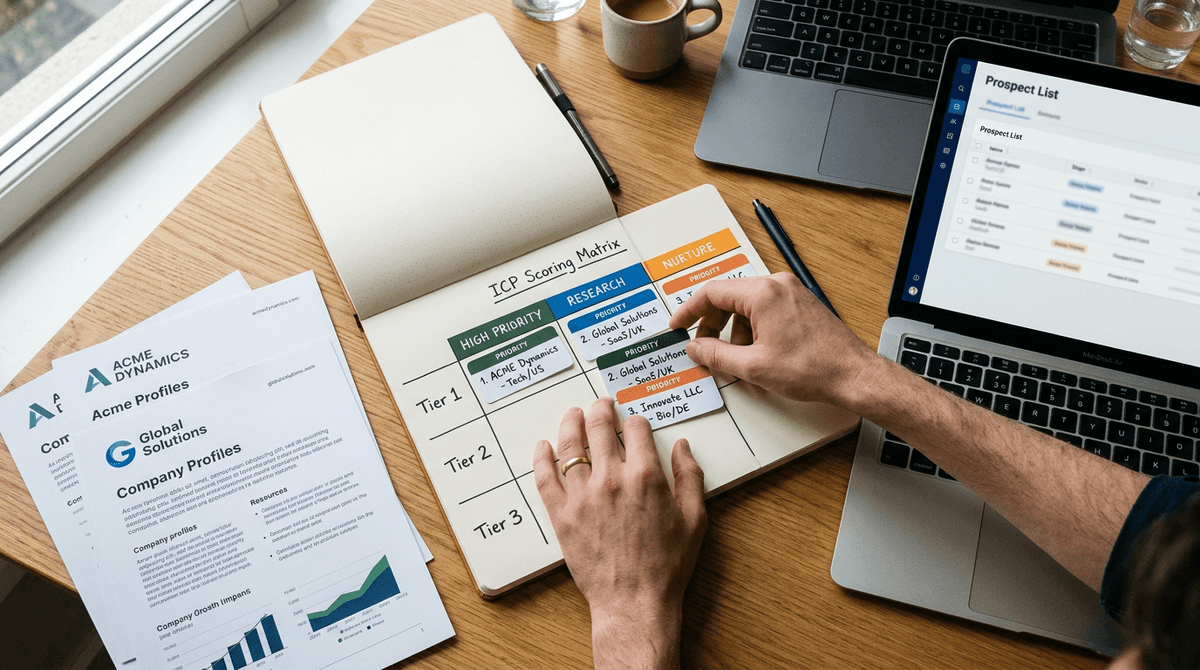
What is sales intelligence software?
Sales intelligence software helps sales teams understand which companies to target, who to contact, what is happening inside those accounts, and how to make outreach more relevant.
In the past, sales intelligence mostly meant data: company details, contact records, direct dials, email addresses, firmographics, technographics, and intent signals.
That still matters. But sales teams now need more than raw data. They need account context, buyer context, relationship visibility, messaging angles, and meeting prep. The best sales intelligence tools help reps move from information to action.
Quick comparison: best sales intelligence software
| Tool | Best for | Best-fit team |
|---|---|---|
| Flyfish | Turning account and lead intelligence into sales-ready outputs | SDRs, BDRs, AEs, and sales-led B2B teams |
| ZoomInfo | B2B contact and company data | Teams that need a large data provider |
| Apollo | Prospecting data plus sales engagement | Outbound SDR teams |
| LinkedIn Sales Navigator | Lead search and relationship signals | Reps who rely heavily on LinkedIn |
| Clay | Data enrichment and custom workflows | RevOps and technical GTM teams |
| 6sense | Intent and account prioritization | ABM teams and enterprise revenue teams |
| Demandbase | Account-based marketing and account intelligence | Enterprise ABM programs |
| Cognism | Compliant B2B data and contact discovery | Sales teams focused on phone and email data |
| Clearbit | Data enrichment and company intelligence | Marketing and RevOps teams |
| Gong | Conversation intelligence and deal insights | Sales teams with high call volume |
Tool
Best for
Best-fit team
Tool
Best for
Best-fit team
Tool
Best for
Best-fit team
Tool
Best for
Best-fit team
Tool
Best for
Best-fit team
Tool
Best for
Best-fit team
Tool
Best for
Best-fit team
Tool
Best for
Best-fit team
Tool
Best for
Best-fit team
Tool
Best for
Best-fit team
How to choose sales intelligence software
Start with the job you need done
Do not start with the vendor list. Start with the workflow problem.
If your team lacks phone numbers and emails, you need contact data. If your team needs to prioritize accounts, you may need intent and firmographic signals. If reps already have data but struggle to turn it into relevant outreach and prep, you need sales intelligence that connects context to action.
Look at data depth and data usability
A large database is useful, but only if reps can use it. Sales intelligence should help reps answer practical questions: Why this account? Why this buyer? Why now? What should I say? Who else matters?
Check how well it supports personalization
Personalization should go beyond using a company name or job title. Good sales intelligence helps reps connect the message to the account's priorities, the buyer's role, and the likely business problem.
Make sure it fits the sales workflow
A tool that only lives in RevOps may not help reps day to day. A tool that only lives in the CRM may not help before the opportunity exists. The best fit depends on where the research and prep work actually happens.
1. Flyfish
Flyfish is built for sales teams that need to turn prospect data into usable sales intelligence and prep. It helps reps find accounts, find leads, generate account intel, understand buyer context, build relationship maps, write outreach, create battle cards, prepare objection handling, and plan meetings.
Flyfish is strongest when reps already have too many disconnected tools and still spend too much time figuring out what matters. It is less about storing data and more about turning account and lead context into the next sales action.
Best for: SDRs, BDRs, AEs, and sales teams selling complex B2B products.
2. ZoomInfo
ZoomInfo is one of the most established sales intelligence platforms. It is widely used for B2B company data, contact data, intent signals, enrichment, and go-to-market research.
It is a strong fit for teams that need a broad data provider and have the budget and processes to support it. The gap is that raw data still needs to be interpreted. Reps may need additional tools to turn that data into messaging, meeting prep, and deal strategy.
Best for: sales and marketing teams that need a large B2B data source.
3. Apollo
Apollo combines prospecting data with sales engagement. Reps can search for accounts and contacts, build lists, and run outbound sequences from the same platform.
Apollo is useful for outbound teams that need list building and execution. It may not go as deep on account strategy, relationship mapping, or meeting prep, so teams often pair it with research or AI tools.
Best for: SDR teams that want prospecting data and outbound execution in one place.
4. LinkedIn Sales Navigator
LinkedIn Sales Navigator is useful for finding people, tracking account activity, and spotting relationship signals inside LinkedIn. It is often one of the first tools reps use when researching buyers.
Its limitation is that it is not a full sales intelligence workflow. Reps still need to interpret the information, connect it to account priorities, write the message, and prepare for the meeting.
Best for: reps who rely heavily on LinkedIn for lead research and warm pathing.
5. Clay
Clay is a strong data enrichment and workflow tool. It lets teams pull from multiple providers, enrich records, use AI for research, and build custom outbound workflows.
Clay is powerful for technical GTM teams, but it may be too complex for a frontline rep who wants a guided workflow. It is often best owned by RevOps, growth, or outbound operations.
Best for: operators who want control over enrichment and prospecting workflows.
6. 6sense
6sense helps revenue teams identify in-market accounts, prioritize buying signals, and support account-based marketing motions.
It is especially useful when sales and marketing teams are working from a target account list and need to prioritize where to focus. It is less focused on rep-level sales prep and personalized outreach creation.
Best for: ABM teams and larger revenue organizations.
7. Demandbase
Demandbase supports account-based marketing, advertising, intent, and account intelligence. It helps teams understand and engage target accounts across marketing and sales.
Demandbase is a strong fit for enterprise ABM programs. Smaller teams may find it more than they need if the immediate problem is SDR research and outreach prep.
Best for: mature ABM teams that need account-level targeting and engagement.
Sales intelligence vs sales engagement
Sales intelligence helps teams understand who to target and what matters. Sales engagement helps teams run outreach and manage activity. Both can be useful, but they solve different problems.
If your team has weak data, start with sales intelligence. If your team has strong data but poor follow-through, sales engagement may help. If your team has data and sequences but still writes generic messages, you may need a layer that turns intelligence into sales-ready outputs.
When Flyfish is the right fit
Flyfish is a strong fit when reps already have tools but still spend too much time stitching things together. They may use a CRM, LinkedIn, a data provider, ChatGPT, and a sales engagement tool, yet still struggle to create account-specific messaging and prep.
Flyfish helps connect the dots between account research, lead context, relationship mapping, outreach, battle cards, objections, and meeting prep.
Final recommendation
The best sales intelligence software depends on the problem you are trying to solve. If you need contact data, choose a data provider. If you need intent, look at ABM platforms. If you need custom enrichment workflows, look at Clay. If you need reps to turn account and lead intelligence into better conversations, look at Flyfish.
For B2B teams, the next wave of sales intelligence is not just more data. It is faster understanding and better action.
Try Flyfish free
Try Flyfish free: Generate account intel, lead snapshots, relationship maps, outreach, battle cards, and meeting prep in minutes. Visit https://flyfish.ai